Drawn to the Shadow
What the Masculinity Crisis Is Really Showing Us

A few years ago, when I first started this Substack, I wrote a piece comparing Jordan Peterson and Andrew Tate. At that point, I had gained genuine insight from Peterson’s work, but I was growing frustrated by his reluctance to speak with conviction about his faith. Tate, by contrast, had recently embraced Islam and seemed full of certainty.
In hindsight, I believe both obscured more than they revealed. Over time, I came to see their public platforms as becoming increasingly oriented toward influence and personal prominence rather than the pursuit of truth. That is, of course, my interpretation. Only God truly knows what was in their hearts.
What I’ve come to understand is that people can sincerely believe they are making a difference while unknowingly serving someone else’s agenda — the classic “useful idiot.” The sincerity of the belief doesn’t make the harm any less real, nor does it absolve those who exploit it.
I was not immune. I fell for their words. I praised both of them. Looking back, I realize I was often captivated by certainty rather than discernment.
So, how does this tie into the masculinity crisis so many are talking about?
The challenge isn’t a shortage of voices offering solutions — it’s that many people latch onto a figure and follow them without exercising discernment. Before we can talk about solutions, we need a clearer picture of the problem itself.
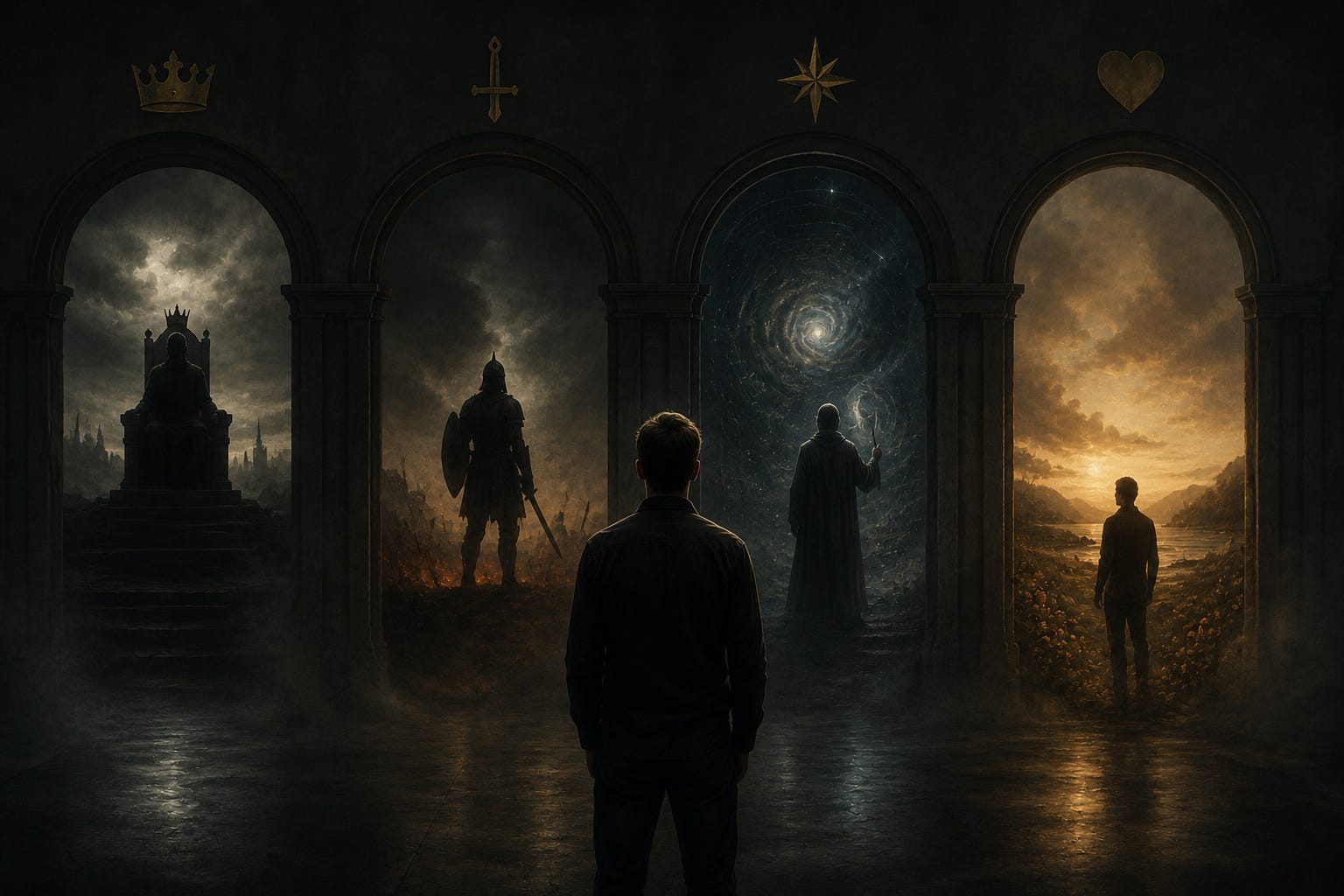
My goal in this piece is to use the framework developed by Robert Moore and Douglas Gillette in King, Warrior, Magician, Lover — which I’ve explored in a previous post — to examine how the shadow side of each masculine archetype manifests in the men our culture often elevates.
The King
The King archetype represents order — for himself and for others — grounded in internal consistency and genuine authority. The mature King creates stability, nurtures growth, and takes responsibility for the well-being of those entrusted to his care.
Its shadow polarities are the Tyrant and the Weakling.
The Tyrant seeks control rather than stewardship. He projects strength while ruling through domination, fear, or self-preservation. The Weakling is his opposite — a man who abdicates responsibility, avoids difficult decisions, and leaves a vacuum where leadership should exist.
Elements of the Tyrant archetype can be seen in many contemporary leaders, but perhaps nowhere more visibly than in Donald Trump. What makes his public leadership style archetypically interesting is its oscillation between force and deal-making. At times, he has embraced rhetoric that emphasizes overwhelming military strength and decisive retaliation, while at other times presenting himself as the negotiator capable of ending conflicts through diplomacy. A healthy King integrates strength and restraint in the service of justice. The Tyrant, by contrast, risks making power itself the defining feature of leadership, leaving others uncertain whether decisions are ultimately guided by wisdom or by the projection of strength.
The Warrior
In his fullest expression, the Warrior embodies disciplined action, courage, clear boundaries, and the capacity to act decisively. He is capable of aggression, but it is channelled — controlled by purpose rather than impulse.
The Warrior’s shadow polarities are the Sadist and the Masochist.
The Sadist attacks, dominates, and humiliates. He seeks strength through the degradation of others. The Masochist, by contrast, turns his aggression inward, becoming passive, resentful, and unable to stand up for himself.
Andrew Tate’s public persona reflects many characteristics of the Warrior’s shadow. What is presented as strength frequently appears as domination, provocation, and the pursuit of status rather than disciplined courage. From a psychological perspective, the Sadist often attacks qualities he fears within himself — a dynamic Freud described through projection, where insecurity is displaced onto others.
The Magician
The Magician represents cognition, awareness, wisdom, and the capacity for deep reflection. Through study, observation, and experience, he develops insight into himself, others, and the world around him.
At his best, the Magician seeks truth before ideology. He uses knowledge to illuminate rather than dominate. He remains intellectually curious and humble enough to revise his understanding when reality challenges his assumptions.
The Magician’s shadow polarities are the Detached Manipulator and the Denying Innocent.
The Detached Manipulator uses knowledge as a tool for personal influence rather than shared understanding. He becomes more comfortable analyzing life than participating in it.
At times, Jordan Peterson’s public persona appears to reflect aspects of this shadow. When asked about his relationship with God, he has often responded with intricate philosophical formulations rather than direct personal testimony. Whether intentional or not, this can leave the impression of someone more comfortable inhabiting the architecture of ideas than the vulnerability of lived faith.
The Denying Innocent possesses enough knowledge to sound convincing but lacks the humility to recognize the limits of his own understanding. He mistakes certainty for wisdom and analysis for genuine discernment. Peterson’s public response to Benjamin Netanyahu following October 7th clearly illustrated this polarity. For a man who had built his reputation on careful thinking and moral seriousness, the tweet revealed a striking lack of wisdom and situational awareness — directly contradicting the very qualities he had long claimed to champion. It cost him significant credibility, and he has largely retreated from public life since, whatever the stated reasons.
The Lover
The Lover engages life with passion, compassion, creativity, and sensory presence. He plays, he connects, he feels, and he experiences life deeply.
His shadow polarities are the Addicted Lover and the Impotent Lover.
The Addicted Lover cannot ground himself. He is perpetually restless, chasing pleasure, novelty, validation, and instant gratification. Often, he is attempting to fill a deeper wound — frequently described as the mother wound — seeking, through conquest and validation, what was never securely received in early life.
The Impotent Lover is his mirror image — a man so wounded by disappointment, rejection, or betrayal that he withdraws from life altogether. He becomes disconnected from himself and others, drifting into boredom, depression, cynicism, and emotional numbness.
Both forms are increasingly common in a culture that struggles to distinguish genuine intimacy from temporary gratification.
The purpose of this exploration is not to offer a simple solution — the masculinity crisis is far too complex for that. Rather, it is to sharpen our vision. Moore and Gillette’s framework gives us a map for understanding what we are actually seeing when we look at the men our culture celebrates, follows, and imitates.
And what we are seeing, more often than not, are shadows.
The danger is not simply that these men are flawed — all men are. The danger is that we follow them precisely because their shadow expressions feel like strength. The Tyrant looks like a leader. The Sadist looks like a warrior. The Manipulator looks like a sage.
Perhaps this is why these figures become so influential. They externalize parts of the masculine psyche that many men have never fully integrated. A man who feels powerless gravitates toward the Tyrant because he mistakes domination for authority. A man disconnected from healthy aggression admires the Sadist because he mistakes cruelty for courage. A man hungry for certainty follows the Manipulator because he mistakes intelligence for wisdom.
We are often drawn to the shadows we have not yet confronted within ourselves.
The work, then, is not to eliminate the shadow but to become conscious of it. We all carry these archetypes within us. The task is to cultivate their fullest expression — especially now, in a culture that seems increasingly unsure what a good man actually looks like.
The mature man does not need to dominate because he possesses genuine authority. He does not seek conflict because he has disciplined strength. He does not hide behind ideas because he has cultivated wisdom. He does not chase endless validation because he has learned to love deeply without becoming enslaved to desire.
And perhaps that is where we must begin — not by finding better leaders to follow, but by doing the harder work of becoming better men ourselves.